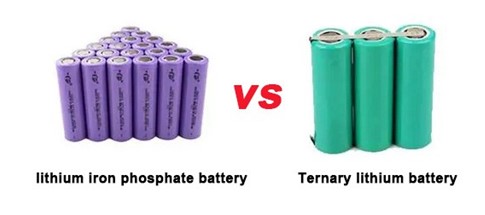
In recent years, due to the increasingly serious environmental pollution, countries are scrambling to develop new energy vehicle industry, as a pure electric vehicle and hybrid power supply, lithium-ion battery is becoming the main source of vehicle power with its low cost, long life, high specific energy and high specific power. Currently, the mainstream batteries used in electric vehicles are lithium iron phosphate (Li-FePO4) batteries, which are popular because of their good safety performance, long life and high cost-effectiveness. Furthermore, the ternary material Li(NixCoxMnx)O2 battery with high specific capacity of LiNiO2, excellent cycling performance of LiCoO2, high safety and low cost of LiMn2O4, It has also become an important choice for electric vehicle power batteries. In practical use, under the low temperature environment has a large impact on the capacity, energy, internal resistance and power of the battery. This paper tests the low temperature performance of the battery through various experiments.
1.Ternary material battery low temperature performance test method
(1) Battery pack capacity and energy test methods
At 25℃, charge the battery pack at 0.5C charge rate, until the battery voltage is reached the maximum allowable charge cut-off voltage for a single unit. The next step is to cool down the battery, when the temperature has stabilized at the specified temperature, Start discharging, until the battery voltage is reached the lowest allowable discharge cut-off voltage of a single unit, record the discharge capacity and energy at this time.
(2) Battery pack DC internal resistance test method
Under the SOC 100%, 90%, 80%, …10% state, With the entire vehicle accelerating, discharged for 10s with the average discharge current of the highest power output, and calculate the value of the DC internal resistance at the end of 10s.
(3) Battery pack low temperature power test method
According to the capacity test data, discharge the battery pack, then test the power values at five points: 90% SOC, 60% SOC, 30% SOC, 20% SOC, 10% SOC, the next step is discharge with constant power, derive the discharge power for 5s and 10s.
2. Analysis of test results
As the environmental temperature decreases, the capacity efficiency and energy efficiency of both battery packs are decreasing. Because of the dynamics, when the environmental temperature decreases, the rate of redox reactions within the battery decreases, the ion movement slows down, and the internal resistance of the battery rises, which leads to a decrease in its discharge capacity. At the same time, as the environmental temperature decreases, the battery has an automatic heating effect, and the battery voltage slowly recovers in the middle of the discharge after a sharp drop at the beginning, and some of the energy is used for self-heating to increase the temperature of the battery, which makes its discharge capacity and energy decrease.
The capacity efficiency and energy efficiency of the ternary battery pack at low temperatures are higher than that of lithium iron phosphate, and as the temperature decreases, its capacity efficiency and energy efficiency decline rate is lower than that of lithium iron phosphate, which indicates that the low-temperature performance of the ternary battery pack is better than that of lithium iron phosphate battery pack.
Firstly, this is because a ternary material battery energy density is higher than lithium iron phosphate material battery, so under the same conditions, its energy efficiency is higher than lithium iron phosphate battery. Secondly, the internal resistance of the ternary material battery is slightly larger than the lithium iron phosphate battery, so in the discharge process, the heat released by the ternary material is relatively high, due to the relatively tight arrangement of the battery cell in the battery pack, so part of the heat can not be discharged in a timely manner, this leads to an increase in the surface temperature of the battery cell, in a low-temperature environment, with the rise in battery temperature, this has resulted in the rate of the battery’s internal electrochemical reaction increases, the ion mobility rate accelerated and increased discharge capacity. Therefore, the discharge capacity and discharge energy of ternary material batteries are higher than those of lithium iron phosphate batteries.
(2) Battery pack low temperature DC internal resistance test analysis
DC internal resistance consists of three components, which are ohmic internal resistance, concentrated polarization internal resistance and activation polarization internal resistance. The ohmic internal resistance is determined by the material of the battery itself, so once the ohmic internal resistance is determined, its value is constant. Activation polarization internal resistance is determined by the nature of the electrochemical reaction system, once the battery system and structure have been determined, its activation polarization internal resistance is also determined. Concentration polarization internal resistance is caused by changes in the concentration of ions participating in the electrode reaction, consequently, a decrease in the environmental temperature will reduce the ionic activity inside the battery, the rate of ionic mobility decreases, the concentration of ions involved in the electrochemical reaction is also reduced, and the internal resistance of the battery rises. Therefore, as the temperature decreases, the DC internal resistance is increasing.
(3) Comparison of low-temperature power performance of battery packs
As the environmental temperature decreases, the power values of both battery packs are decreasing, this is because the temperature decreases causes the electrochemical activity inside the battery cell to decrease, thus, the battery’s discharging ability is weakened, and at the same time, as the SOC decreases, its discharge power also gradually decreases, this is because as the battery capacity decreases, its discharge ability gradually decreases, resulting in a lower power value. Through comparison, it can be found that the low-temperature power of ternary material batteries is significantly higher than that of lithium iron phosphate batteries, which indicates that ternary material batteries are significantly better than lithium iron phosphate batteries in terms of low-temperature power characteristics.
3. Conclusion
Through the above electrical performance test analysis, it can be obtained that the low-temperature performance of the ternary material battery pack are better than the lithium iron phosphate material battery. Preliminary analysis shows that the lithium iron phosphate material is olivine structure, which belongs to orthorhombic strain, resulting in slow lithium ion migration and low electron transfer rate, which greatly restricts its low-temperature performance. Replacing lithium iron phosphate batteries with ternary material batteries has certain feasibility and applicability as the main power core of future electric vehicles.